
What is Center of Gravity
The center of gravity (or center of mass) of an object is the average location of the weight (or mass) of an object in space. An object suspended from its center of gravity in space will be perfectly balanced. A force applied to the center of gravity causes pure translation. A force not applied through the center of gravity makes the object rotate about its center of gravity. When it comes to design of aircraft, spacecraft and even automobiles, calculating the center of gravity is an important part of the process.
We offer a complete solution to measure Center of Gravity that includes a fully built scale with grids, sensors, and software. However, you could build your own custom scale using the sensors and CG software we offer.
Why Center of Gravity Matters: From Drones to Automobiles
From unmanned drones carrying a shifting payload of batteries, cameras, and sensors, to aircraft undergoing a pre-flight weight-and-balance check, few measurements matter as much as center of gravity (CG). Get it right, and a vehicle flies stable, efficient, and controllable. Get it wrong, and even a well-engineered aircraft can become difficult to handle — or unsafe to fly.
Whether you're a drone manufacturer verifying balance after a payload or battery change, an aerospace team performing weight-and-balance checks in production or the field, or an engineer designing for stability in any moving object, knowing the precise CG location is the essential first step.
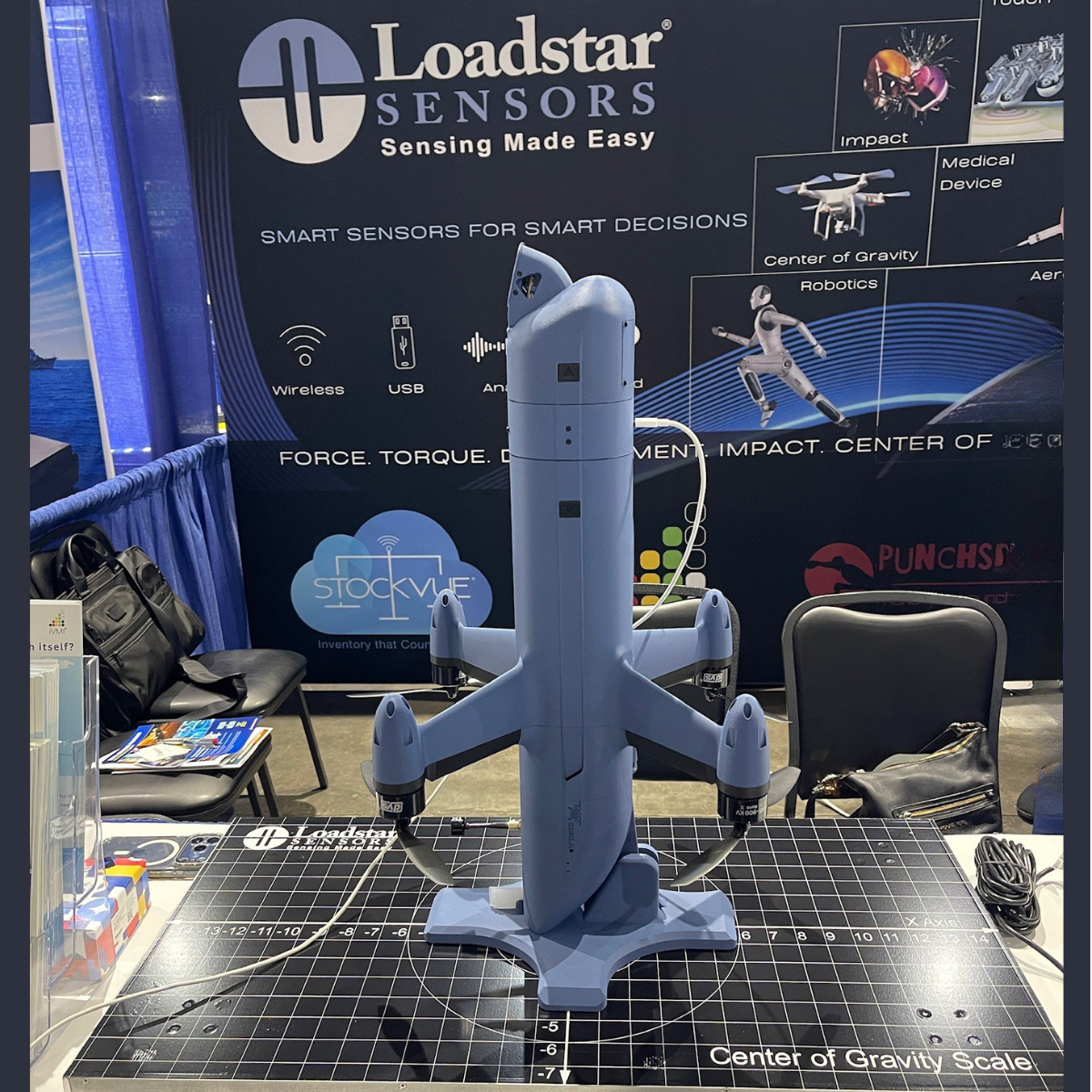
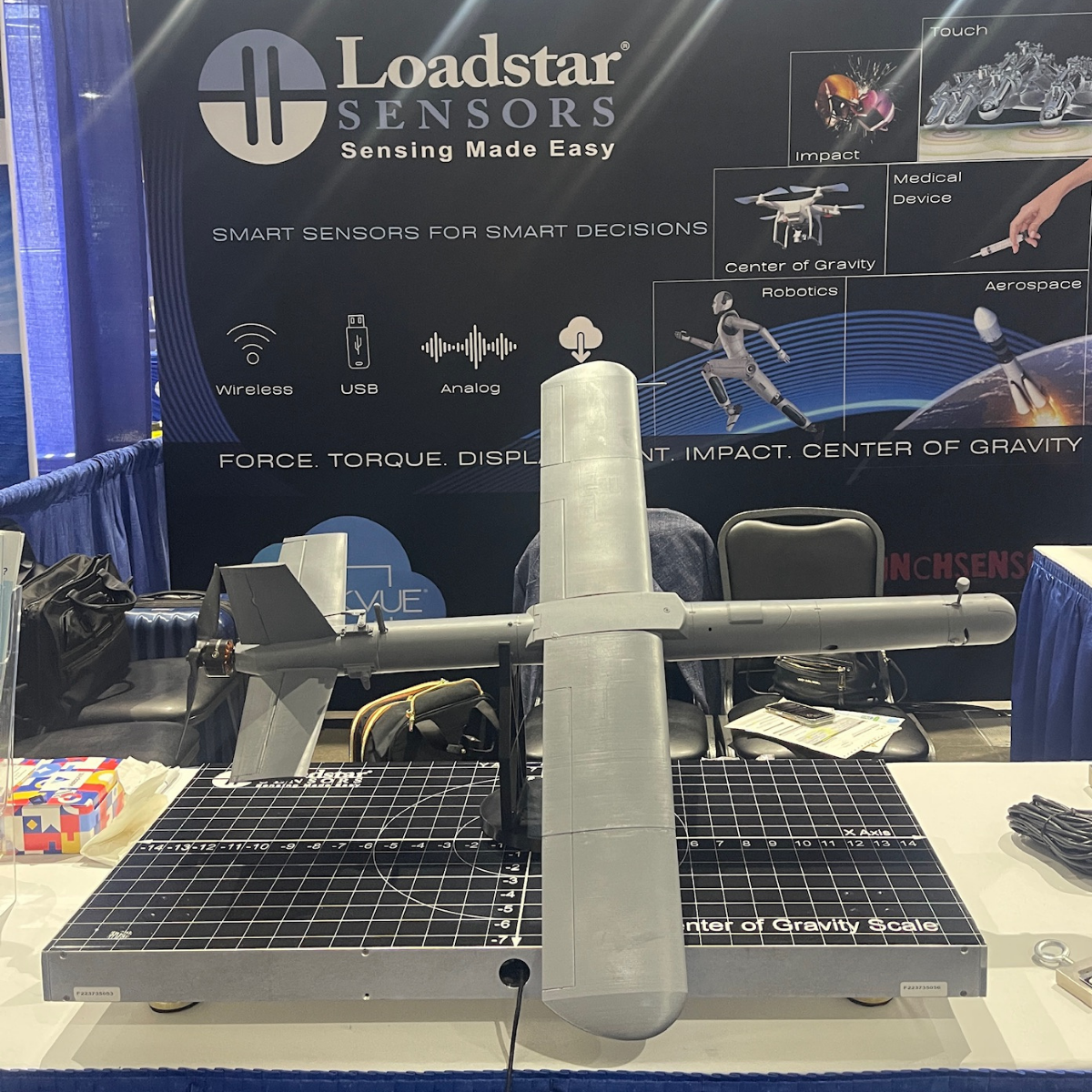
And flight is far from the only place balance is mission-critical:
- Shipping & Logistics — Verifying the CG of heavy packages, crates, and pallets before transport helps prevent tipping and shifting during handling, forklift operation, and freight transport.
- Healthcare & Rehabilitation — Clinicians and researchers use CG measurement to study human weight distribution and balance in real time, supporting patient balance training, gait analysis, and rehabilitation programs.
- Robotics & Automotive — A low, well-centered CG improves stability and control in everything from robotic platforms to vehicle design, reducing tip-over and rollover risk.
Whatever the object, the underlying physics is the same — and it starts with understanding exactly what center of gravity is and why it's so critical to get right.
Trusted by Leading Teams








How to calculate the Center of Gravity of an object?
The center of gravity of an object can be calculated by placing an object on a multiple sensor scale - typically done with a four load cell scale or three load cell scale. The object is placed at the center of the scale platform. The weight of the object is measured at the four corners individually and the location of the four load cells with respect to the origin is used to compute the sum of the moments and this sum is divided by the total weight to calculate the locations of its x and y position.
Xcg = (W1*X1 + W2*X2 + W3*X3 + W4*X4)/(W1+W2+W3+W4)
and
Ycg = (W1*Y1 + W2*Y2 + W3*Y3 + W4*Y4)/(W1+W2+W3+W4)
The object can be rotated by 90 degrees and the same process repeated to calculate the center of gravity in the other plane.
Highlights of our Center of Gravity Solution
- Platform Scale with four USB Load Cells
- Power & Data via USB port
- Easy to use LV-4000CG Software
- Calibration to NIST Standards with certificate
- Calibration stored in sensor
- Software compatible with Win 10/11
- Data updated at up to 40-60 Hz
- Place on desk or floor & level scale before use
- Made using light weight Aluminum with a grid
- Display, Log & Plot data in a user friendly GUI interface
- Accuracy of each load cell is of the order of +/- 0.025% of full scale
- Accuracy of scale overall is around +/- 1% of capacity
- See Center of Gravity in real time with live tracking
- Store data in a CSV file and open in Excel, Matlab etc.
Center of Gravity Scale
The 2 ft x 2ft CG Scale includes, a platform with 1 inch square grid, four load cells, adapters, leveling feet, four channel USB load cell interface, and LV-4000CG software provided on a USB Drive or as a downloadable link. Calibration certificates for each load cell are included showing traceability to NIST standards. Use with a PC or tablet with Win 10/11 operating system, 8 GB RAM and enough disk space to capture data (500 GB should be more than enough).
If you would like to build your own custom size CG scale, please take a look at the CG kit.
How it Works
- The scale is built using four load cells installed at the four corners of a platform built using stiff aluminum framing. The platform has etched grid on the surface to locate CG.
Designing and building a stiff frame is critical to get good accuracy from the load cells. The weight of the object in each of the four corners must go down vertically so that no moments or side loads are applied to the load cell ideally.


The scale as shown is built using four RAS1 resistive load cells installed at the four corners of a platform built using aluminum framing and one DI-400U USB Interface or four DI-1000U USB Interfaces calibrated together in compression. The DI-400U can be used to get moderate accuarcy with +/- 0.1% of full scale. Four DI-1000U interfaces can be used to get accuracies up to 0.02% to 0.05% of full scale per corner.
Alternatively, use RSB6 load cells for lower profile, thinner scales.
The location of the Center of Gravity is calculated using the simple formula:
Xcg = (W1*X1 + W2*X2 + W3*X3 + W4*X4)/(W1+W2+W3+W4)
and
Ycg = (W1*Y1 + W2*Y2 + W3*Y3 + W4*Y4)/(W1+W2+W3+W4)
You can compute the CG of an object in 3D by calculating the CG in two dimensions first and then tilting the platform by a known angle and then measuring the new CG again and figuring out the CG in 3D using transformations. We do not offer a 3D solution yet as a standard product but could offer a solution to interested customers in the future. Please contact us for your custom CG scale needs.


The LoadVUE Pro Center of Gravity software is to be used with the CG Scale to compute and display the Center of gravity of objects in two dimensions. The individual weights or forces on each load cell is displayed as well as the CG of the object in 2D space is shown as a dot whose diameter varies with the total weight of force of the object. The software supports both a three point Center of Gravity or four point Center of Gravity.
It can be used to monitor static as well as dynamic change of the CG in real time in order to study the weight and balance distribution of human beings or animals. The size of the scale as well as the capacity of the scale can be changed to meet your needs. A few standard configurations are available for purchase. Please contact us for your custom CG scale needs.
Watch and Learn
This CG scale was built using iLoad Pro load cells but you can follow the same process to build the CG scale with higher accuracy load cells like RAS1 or RSB6 load cells.


Build Your Own Center of Gravity Scale

Center of Gravity using four RAS1 load cells

Center of Gravity using four RSB6 load cells
High Accuracy CG Kit with RAS1 Load Cells and 24-Bit Digital Interface
This kit includes four RAS1 load cells, four DI-1000U 24-bit digital intreface, 1 HX-400 USB hub, and LV-4000-CG software. The kit comes precalibrated in compression mode with NIST traceable calibration certificates. You just have to build a sturdy, rigid frame, place a platform on it and place the object that you need to measure the CG of on it. You will need a WIn 8/10/11 PC or Tablet with 8 GB RAM and at least 500 GB of disk space. We include four load buttons to help you level the scale once built on the surface where you'll be placing it.

High Accuracy CG Kit with RSB6 Load Cells and 24-Bit Digital Interface
This kit includes four RSB6 load cells, four DI-1000U 24-bit digital intreface, 1 HX-400 USB hub, and LV-4000-CG software. The kit comes precalibrated in compression mode with NIST traceable calibration certificates. You just have to build a sturdy, rigid frame, place a platform on it and place the object that you need to measure the CG of on it. You will need a WIn 8/10 PC or Tablet with 8 GB RAM and at least 500 GB of disk space. We include four load buttons to help you level the scale once built on the surface where you'll be placing it.

